
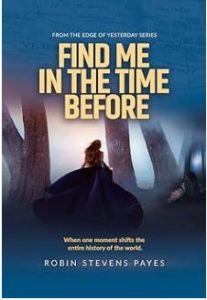
 Today’s podcast episode is a Book Award Winner episode, where we get to know a writer who won the NAIWE Book Award.
Robin Stevens Payes won the 2023 Book Award for her book Find Me in the Time Before in the Young Adult category.
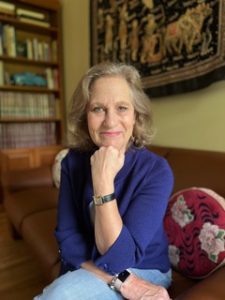
Robin Stevens Payes is a time traveler who reasons that time and space are just inconvenient rules that other people decided the world must follow. She’s author of the award-winning Edge of Yesterday YA time travel adventure book series chronicling a “whip-smart” modern teen’s quest to meet—and interview—all her polymathic “heroes of history” to learn the secrets of their genius. She has recently completed a pilot screenplay adaptation for television or streaming with screenwriting partner Tish Dragonette.
Payes also has two short stories scheduled to appear in anthologies in late 2024. And after decades of trying to fit some notion of “normal,” in 2023, she chose to dive deeper into the offbeat, allowing verse to fill a poetic void. Her poetry has appeared in two anthologies: Maryland Bards Poetry Reviews in 2023 and 2024 and Reflections Maryland Writers’ Association Anthology in 2023.
To make time travel available to teens and those who care for them, Payes has created an accompanying interactive “learning through story” platform where she prompts teens to follow their own inner voice—through poetry, prose, photography, personal reflection and other forms of creative expression.
 Here is a preview of today’s discussion:
When did you first have the idea for this book? And what inspired you to actually write this book?
As a science writer, I became fascinated with the brilliant but forgotten 18th-century French woman physicist, mathematician, and philosopher, Emilie, the Marquise du Châtelet, after being introduced to her in a documentary about Einstein’s breakthrough formula for Relativity, based on David Bodanis’s biography of a formula, E=mc2. According to Bodanis, the Marquise laid the foundation for Relativity two centuries before Einstein. Her contribution, F=mv2 the squaring of Newton’s formula for energy, was actually an improvement on Newton’s math. And that she was something of an 18th-century feminist (long before there was such a notion of female empowerment) made her all the more intriguing!
The book’s protagonist, the very 21st-century STEMinista and now-experienced time traveler, Charley Morton, whose ambition in life is to “do it all” and not be confined by what her society tells her she can or cannot become, was dying to learn Emilie’s secrets of polymathic success, so for her high school science fair project, she must refine her time travel app and set it for France in 1736, in the time of Emilie and her lover and science partner, the infamous satirist, poet and playwright (and, fun fact, scientist wannabe) Voltaire.
For curious readers, Charley has captured the life and accomplishments of this “daring genius of the Enlightenment,” in an interview with the great marquise.
Please describe one of your favorite characters from your book.
I love all my characters, but Emilie is such a kick-butt woman that she stands head-and-shoulders above the rest. As I mentioned, she was physicist, mathematician and philosopher, but also mother of four (she died in childbirth with her youngest at the age of 42—that child was neither her husband’s nor Voltaire’s, but a minor court poet at Versailles, Saint-Lambert, a student of Voltaire. She and Voltaire created one of the most modern science laboratories in Europe when they went to live in the château in Cirey, France, where she and Voltaire took up residence for 15 years, and her husband, the Marquis, would visit when he wasn’t off fighting wars for King Louis XV. She had to bring Voltaire to Cirey to save him from exile (again!) after he insulted a member of Louis’s nobility at Versailles.
The two set up a salon where all the greatest minds across Europe would gather to exchange ideas and debate the most modern philosophical and scientific breakthroughs. She built a little theatre at the top of the château to perform Voltaire’s plays, and commandeered their guests to play roles. Emilie also sang opera—and there is now even an opera dedicated to her story.
All was lost when she died at such a relatively young age. There is so much to this amazing woman!
Do you have a tried-and-true writing technique? Please share your writing process.
It’s funny you bring up this question. I was asked in another interview recently whether I am a plotter or a pantser. Being the science writer I am, I love to see the plot laid out before I start writing, and to neatly tie up the story arc, and what’s happening chapter-by-chapter. so I am a plotter by nature.
However, Charley is definitely not! I start writing following my neat outline, and she takes it from there—taking me on the adventure with her. Whatever happens from there, like the aforementioned multi-time leaps from present to past to future to past to present, is a mystery to me until it unfurls.
Charley definitely keeps things fresh.
Leave a Reply