
 Today’s podcast episode is a Book Award Winner episode, where we get to know a writer who won the NAIWE Book Award.
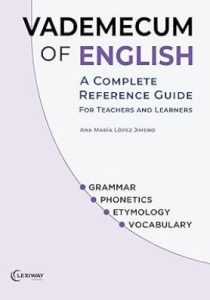
Ana Maria Lopez Jimeno won the 2025 Book Award for her book Vademecum of English. A Complete Reference Guide for Teachers and Learners in the Reference category.
Ana Maria Lopez Jimeno is a linguist and language educator with over 40 years of teaching experience across three languages — English, Spanish, and Arabic. She founded a language academy and the first English kindergarten in Toledo, Spain, and she has spent the last several years teaching Spanish to refugees and migrants as a volunteer with the Spanish Red Cross. That combination — rigorous linguistics on one side, grassroots language access on the other — is what shaped both her teaching methodology and, eventually, her latest book. She is currently working toward a Doctorate in Didactics of Languages.
 Here is a preview of today’s discussion:
You recently had your book Vademecum of English published, which is a reference book on the English language. There are many other reference books that have been published. Can you tell us about your book and the need it fills?
Vademecum of English is a structured reference handbook for English teachers and advanced learners, organized into over one hundred charts covering phonetics, grammar, vocabulary, and etymology. The premise is simple: teachers should be able to find a clear, well-reasoned explanation for any aspect of the language in a single place, without consulting multiple sources that often contradict each other. Nearly half the book is devoted to etymology and morphology — what I call etymorphology — because understanding how words are built is, in my experience, the most powerful tool for genuinely owning a language.
What did you learn while working on this book? And what were some challenges you faced during the writing or publication of this book?
The main challenge was restraint. There is always more to say about language, and deciding when a chart was clear enough — without becoming a dissertation — required constant discipline. I also learned that explaining something simply is considerably harder than explaining it in full complexity. The grammar sections went through many revisions because I was not willing to state a rule without showing the logic behind it. Finding that logic sometimes meant going back to historical linguistics; sometimes it just meant sitting with the question until a better answer came.
What avenues have you used to market your book? And which ones were the most successful for you?
Book award competitions have been more effective than I expected — not for the visibility alone, but because recognition from independent juries gives other educators a concrete reason to take the book seriously. Reviews from within the professional teaching community, particularly TESOL Spain, reached exactly the right readers. Word of mouth among teachers has also been significant; it is a practical profession, and recommendations travel fast when something actually works in the classroom.
Leave a Reply