
National Association of Independent Writers & Editors
Facebook Instagram Linkedin twitter

Search

SubscribeLogin

  • About
    • About NAIWE
    • Board of Experts
    • Amazon-Affiliate Book
    • FAQs
    • Advertising
  • Join Us
    • Join NAIWE
    • Benefits
    • Reasons to Join an Association
  • Training
  • Find a Professional
  • Blog
  • News & Events
    • The Edge
    • Conference
    • Podcasts
    • Summer Challenge
    • Words Matter
      • Words Matter Week
      • How to Participate
      • Media
  • Post a Job
  • Contact
  • Member Sites

Book Review: Wicked Innocents

December 31, 2021 Post a comment

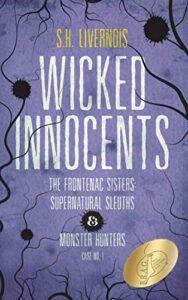
Wicked Innocents

Author: S.H. Livernois


A young girl claims that her family has changed. Not in personality, but as if their bodies have been overtaken. Nelly Huggett does not feel loved by her mother, and people say she exaggerates a bit too much. Fellow classmates have ridiculed her, and her brother doesn’t even like her. So is Nelly telling the truth?

While her aunt takes Nelly in when she runs away from home on the night of Halloween, Aunt Emma believes Nelly is lying. However, it has been three days and no one has answered the phone at the Huggett house, not even a cellphone.

The Frontenac sisters, Hyla and Lizeth, are on the case. As supernatural sleuths, Hyla and Lizeth drive to the home of Aunt Emma at the bequest of a phone call from Nelly. After confronting Emma’s denial that anything is going on in Nelly’s house, the four of them drive to Nelly’s home in search of clues.

In Wicked Innocents, S.H. Livernois quickly builds suspense through the description of the emptiness and eeriness of the Huggett home. And then once the missing family members are discovered, the mystery evolves as the Frontenac sisters continue to investigate to determine if Nelly is telling the truth or filled with anger and lies.

While there is not an overwhelming number of characters, there are a handful of characters that are easily confused. The Frontenac sisters, Hyla and Lizeth, have different strengths, but their personalities are not different enough, making them easily confused. Emma and Gillian, Nelly’s aunt and mother, respectively, can easily be confused, leading to some interactions needing to be re-read. And Miles and Jack, Nelly’s father and brother, can be confused too, especially in a discussion about a dispute with a neighbor.

Though additional description of these characters could be added to further separate them from one another, and this lack of description causes some slowdown in the reading to completely understand a few scenes, this does not take away from the overall enjoyment of the book.

In reading this novel, it was obvious the book is still in need of a proofreader. There were errors in punctuation and a few developmental questions, such as an undifferentiated pronoun, making a sentence difficult to understand.

Overall, we enjoyed this novel. The author has a skill for writing mystery and suspense to capture the audience and involve the reader until the end.

Categories: Book Reviews, Member Benefits

Book Review: Cover to Cover

July 30, 2021 Post a comment

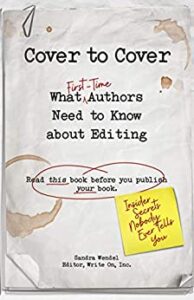
Cover to Cover: What First-Time Authors Need to Know about Editing

Author: Sandra Wendel


First-time authors make mistakes. The publishing process can be a challenge, especially knowing all of the steps and when they are to be completed to develop a best-selling book.

It used to be that a writer would pick up an agent who would then shop the manuscript to various publishers. The writer would then be contacted at various points by the agent or the publisher throughout the publishing process, and the entire process would be completed by professionals who publish books for a living.

Now, the writer can act as the publisher. But what is the process that the book should be taken through?

The writer who is looking to become a published author may be lost after the manuscript has grown and developed as much as possible through the advice given by the writer’s group members. Cover to Cover gives that writer the next-step process beginning with answering questions such as

  • Why do I need an editor?
  • What does (and doesn’t) an editor do?
  • How do I find an editor?

In Cover to Cover, Sandra Wendel, a professional editor, helps first-time authors navigate the editing process. She defines the various types of editing (including book coaching, collaborative writing, and proofreading) from her perspective, as there is, unfortunately, no one set of definitions for these terms.

In addition to preparing authors for the editing budget, Wendel helps authors cut costs by informing them of how to prepare their manuscripts for an edit. In this section, she covers book sections, length, and formatting (including the bold and italics that authors love). She also includes a section on word usage.

To emphasize the importance of authors fine-tuning the manuscript before the editing process begins, Wendel also includes a checklist at the end of the book. While some of the items in the checklist are covered throughout the book, many writers enjoy working through checklists to feel a sense of accomplishment. The checklist is broken down into sections on words, format, parts of the book, punctuation, and graphics and illustrations, leading to a nicely detailed list of items for the author to complete before hiring the editor.

Wendel offers a brief introduction to Microsoft Word’s Track Changes and shows what the editing process will look like for when the author is ready to begin working with an editor.

Early in the book, Wendel delves into some reasons why an author should not depend on a self-edit. “Our brains are just wired to miss our own errors,” Wendel says, providing reasons why even she as an editor does not solely depend upon self-editing. She gives examples of corrections her editor made to Cover to Cover: inelegant phrasing, twisted logic, missing words, misplaced modifiers, and more.

Authors often have readers for the book before an editor is involved in the process, and many authors believe those readers can replace the editor. Wendel includes a section on how a professional editor is different from your English teacher. “We’re also not your high school English teacher, so we will actually make editorial changes for you and leave you kind notes in the margin.”

Even when authors know they need to work with an editor, finding one can seem like a big deal. While “there is no Angie’s List of editors,” Wendel provides some great resources for finding editors that may be a good fit for the manuscript.

Once an author has a list of potential editors, how does one go about selecting the one? Wendel has provided questions to ask during the interview process, and even questions the editor may ask of the author. Knowing what to expect on both sides of the conversation can help to prepare the author for what to expect from the type of editor they want to work with.

In a section on writer’s block, Wendel includes a description of the types of writers in an easy-to-relate-to format. While they are similar to the learning styles—visual, auditory, and kinesthetic—it was interesting to see how these learning styles can also relate to writing styles, leading to how best to overcome writer’s block.

In helping to prepare the author to work with the editor, Wendel offers etiquette suggestions. She calls out the Karen authors and provides reasons why no one should want to be that author—the one who isn’t the most enjoyable to work with. While this was a necessary section to include in the book, especially for those first-time authors, it was too short. So much more could have been said on this topic. While Wendel included some items for the author not to do, she could have included items for the author to do. As well, since most authors and editors communicate electronically or via phone, she could have provided some sample emails or telephone dialogues.

Early in the manuscript, Wendel discusses what the writer should do once the manuscript has been written. Forms of self-editing were discussed, but neither here nor anywhere else in the manuscript did the author discuss the benefits of working through a manuscript with a writer’s group or even a fellow author.

While Wendel discusses why she did not include an index for this book (because she has a descriptive table of contents), an index includes much more detail (and can affect whether a book is picked up by a library, for example).

Finally, while it is expected that the checklist at the end of the book would include some of the same items from within the book, it was a bit disconcerting that early in the book several items were repeated. Perhaps it was to emphasize the importance, but the closeness of the repeated sections made them noticeably stand out.

Overall, we recommend this book for first-time authors (or even for self-publishing authors) who want to create a professional-looking book that is well received by the community and by its readers. The book is well written by an expert editor, and Wendel offers a lot of great information in a relatable format.

Categories: Book Reviews, Member Benefits

  • « Previous Page
  • 1
  • …
  • 4
  • 5
  • 6

Recent Posts

  • Days to Celebrate in May
  • Book Review: Hidden History of Pearson Field
  • Member Benefit: Free Financial Consultations and Personalized Plan Reviews
  • Ruth Thaler-Carter, NAIWE’s Networking Expert
  • Days to Celebrate in April

Categories

Links

  • Member Area
  • NAIWE Bookstore
  • NAIWE- The Association Site
  • Words Matter Week

Meta

  • Log in
  • Entries feed
  • Comments feed
  • WordPress.org

Latest Posts

Days to Celebrate in May

April 24, 2026

Book Review: Hidden History of Pearson Field

April 13, 2026

Member Benefit: Free Financial Consultations and Personalized Plan Reviews

April 10, 2026

Ruth Thaler-Carter, NAIWE's Networking Expert

April 3, 2026

Days to Celebrate in April

March 27, 2026

Achieving with Words

March 20, 2026

Contact Us

  • 804-476-4484
  • P.O. Box 412
    Montpelier, VA 23192-0412
Facebook Instagram Linkedin twitter

© NAIWE. All rights reserved. Designed by My House of Design.