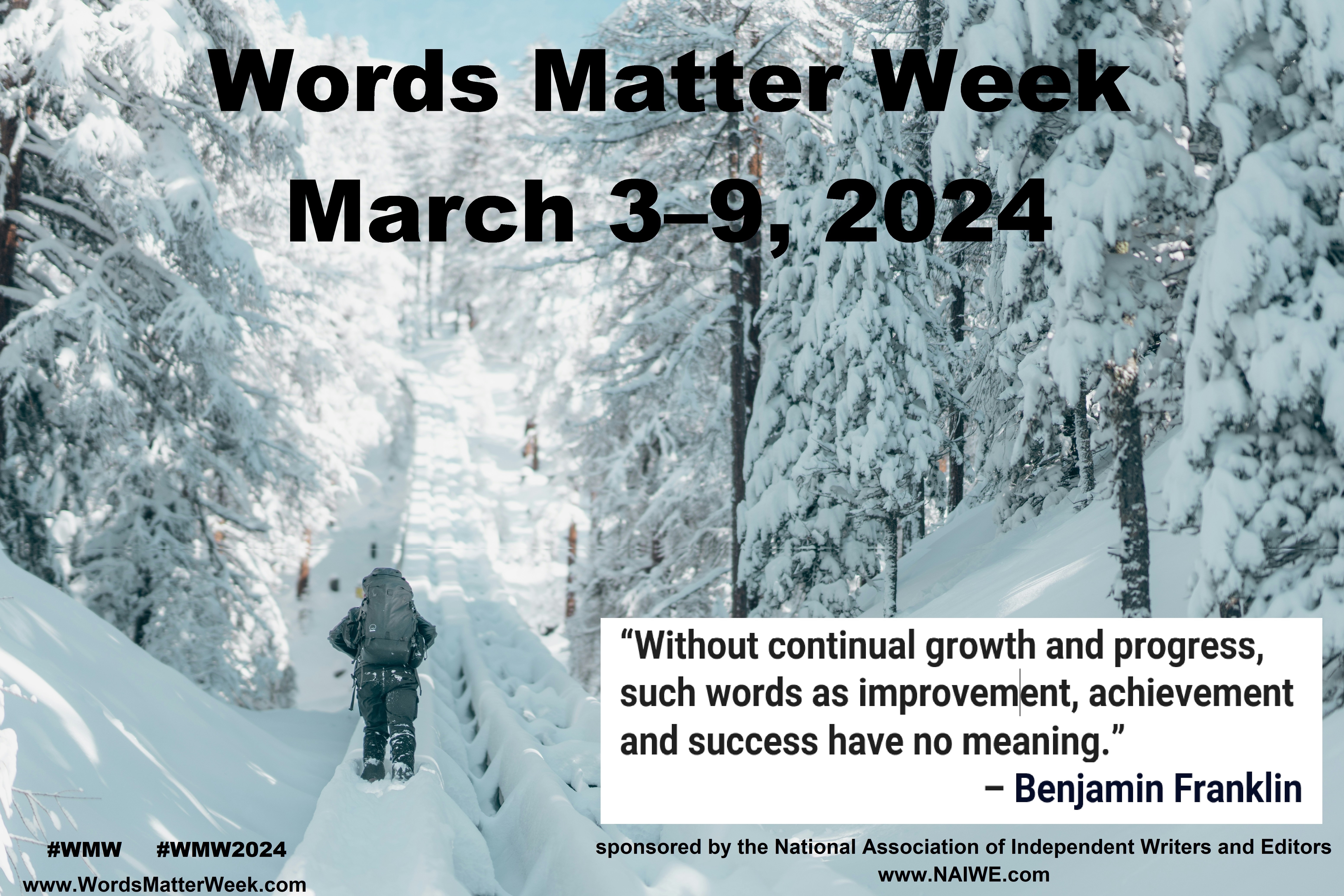
 Writing Challenge Day 1
The word “without” puts limits on what it is being referred back to. Write about a situation when the limit is for positive means.
Prepare for the Writing Challenge
During Words Matter Week, we host a writing challenge. Each day we will post a question on our blog and various social media outlets.
Respond to the question on your blog or social media page (be sure to include #WMW2024 in your response), and then link back to it in the comments of the corresponding article on the NAIWE blog. For each challenge you respond to, you will receive one entry (and a bonus entry for each response written on your NAIWE blog).
At the end of the week, we will have a drawing, and one person will win a fabulous prize, along with a mention and link in the next newsletter.
 Words Matter Week, which is in its 16th year, is a holiday that is celebrated annually the first full week in March by the National Association of Independent Writers and Editors.
 As a professional association, NAIWE is committed to helping its members succeed. All NAIWE members receive tools and training to help them grow in their profession, support as they meet professional challenges, and opportunities to develop their marketing skills so that they can create the kind of career they want.
 I recently received a call from a woman looking to become a proofreader. She wanted advice to break into the field. It had been a while since I have received this type of call, but this is a call that I do receive periodically.
 We encourage everyone in the publishing industry to belong to two professional organizations. The first is a large, general, career-building association such as NAIWE, and the second is a smaller craft- or genre-focused association that will help develop additional skills in the minutiae of your craft.
 It is amazing that there are so many types of people in the publishing industry! While there are many people who love words, as to be expected, there are also many other people with a variety of other loves related to the written word.
 Developmental editing, also known as substantive editing, structural editing, or heavy line editing, can begin even before the author starts writing. The developmental editor may help plan the organization, features, and other aspects of the work. Although the author is technically writing the text, the editor may work with the author to create an outline to help with organization as early as possible in the writing process.
 Learning a new style manual takes time, and part of being a copyeditor is thoroughly knowing at least one style manual. As you edit, you ask questions, often about the same types of changes, so knowing some items to look up when learning a new style manual can give you a head start in the familiarization process. You may even want to create a style sheet for the new style manual.
 NAIWE is always coming out with new
  Books by well-known authors who have died are still read. Why do their words still matter to generations of today?